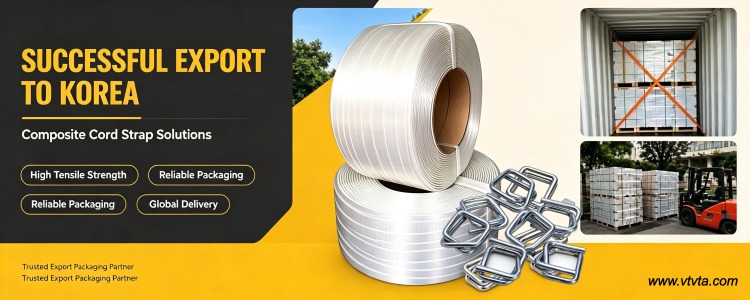
Exporting Composite Cord Strap to South Korea: A Complete Guide for Suppliers and Buyers
South Korea stands as one of Asia Pacific's most dynamic markets for industrial packaging solutions. With its world-class automotive sector, precision manufacturing industries, and rapidly expanding e-commerce logistics infrastructure, the demand for high-performance strapping materials continues to grow steadily. For international suppliers, exporting Composite Cord Strap to South Korea represents a significant opportunity to tap into a market that values quality, safety, and operational efficiency.
Why South Korea Needs Composite Cord Strap
South Korea maintains strong demand for composite strapping from its precision manufacturing and automotive sectors, where the material is preferred for securing high-value components during export shipment-As a major global export hub, Korean manufacturers ship automobiles, electronics, machinery, and steel products worldwide. These shipments require reliable load-securing solutions that can withstand the rigors of multi-modal transportation.
-Traditional steel strapping has long been the default choice for heavy-duty applications, but Korean industries are increasingly switching to Composite Cord Strap for compelling reasons. Composite strapping eliminates the laceration hazard associated with steel snap-back injuries, weighs approximately 70% less than equivalent steel banding, and offers superior shock absorption with an elastic elongation recovery of 1.5% to 2.5%-Unlike steel, it does not corrode or rust-stain packaged goods during ocean freight exposure—a critical advantage for Korea's export-oriented economy.
What Is Composite Cord Strap?
Composite Cord Strap, also known as polyester composite strapping or corded composite strapping, is constructed from high-tenacity polyester filament yarns bonded together with a polymer coating. This advanced engineering creates a strapping solution that is as strong as steel while remaining soft and flexible.
Standard product specifications include widths ranging from 13mm to 32mm, with thickness options from 0.50mm to 1.25mm
The strap is typically supplied in rolls and used in conjunction with wire buckles, tensioners, dispensers, and pallet needles to create a complete securing system.
Key technical advantages include:
-High tensile strength comparable to steel strapping
-No sharp edges that could damage products or injure workers
-Weather and UV resistance for outdoor storage and long-haul shipping
-High retained tension due to elastic elongation and memory properties
-Lightweight handling that reduces worker fatigue and freight costs
-Recyclable materials that support sustainability mandates
Applications Driving Demand
Several industries in South Korea consistently drive demand for composite cord strapping:
--Automotive & Auto Parts: Securing body stampings, powertrain assemblies, and electronics in returnable packaging for just-in-time (JIT) delivery to Hyundai, Kia, and their supplier networks.
--Electronics & Appliances: Protecting high-value consumer electronics, home appliances, and semiconductor equipment during domestic and international transit.
--Construction Materials: Bundling steel pipes, timber, roofing tiles, and prefabricated modules for Korea's ongoing infrastructure development projects.
--Logistics & E-commerce: Pallet unitization and container load securing for the rapidly growing online retail fulfillment sector.
--Agricultural Exports: Securing hay, straw bales, and horticultural products for shipment to international markets.
Export Strategy for Korean Market Entry
For suppliers looking to export Composite Cord Strap to South Korea, several strategic considerations can accelerate market penetration:
--Product Certification: Ensure your products meet international quality standards. Korean buyers typically expect TUV or SGS certification, and ISO 9001 management system certification is highly regarded.--Competitive Pricing: Korean buyers are sophisticated and compare global suppliers. Standard designs typically start at competitive per-meter pricing, with minimum order quantities varying by manufacturer. Many Chinese suppliers offer flexible MOQs for custom specifications.
--Reliable Logistics: South Korea's major ports—Busan, Incheon, and Gwangyang—handle enormous cargo volumes. Suppliers should offer flexible shipping terms (FOB, CIF, CFR) and maintain average lead times of 15–30 days depending on seasonality.
--Local Partnerships: Establishing relationships with Korean distributors or industrial supply companies can provide market access and after-sales support. Many successful exporters to Korea work through agency exportation models or direct distributor networks.
--Digital Presence: Korean procurement managers increasingly research suppliers through B2B platforms and industry-specific portals. Maintaining a strong online catalog with detailed product specifications, response times under two hours, and multi-language support (English and Korean) significantly improves conversion rates.
Conclusion
Exporting Composite Cord Strap to South Korea offers a compelling growth opportunity for manufacturers and trading companies worldwide. With Korea's advanced manufacturing base, strict quality expectations, and growing preference for safer, lighter alternatives to steel strapping, the market is primed for reliable international suppliers.
By focusing on product quality, international certification, competitive pricing, and responsive customer service, exporters can establish a strong foothold in one of Asia's most sophisticated industrial packaging markets. Whether you are a manufacturer in China, India, or Europe, the Korean market rewards suppliers who understand that in the world of cargo securing, performance and safety are never compromised.